Call for Innovation & Awards
Call for Innovation & Awards
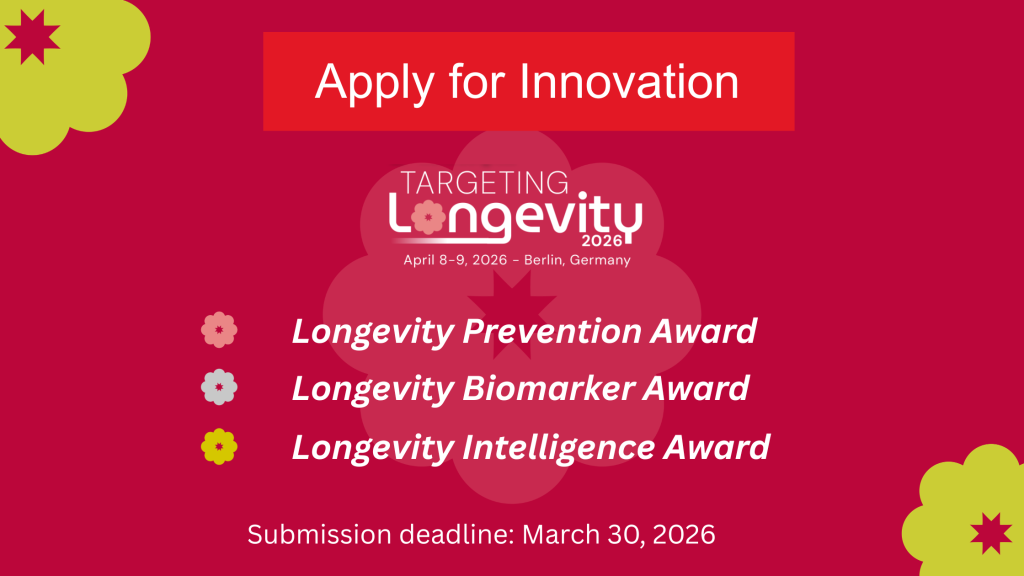
Targeting Longevity 2026 is launching its Call for Innovation, inviting startups, companies, researchers, and innovators to present solutions that help rethink longevity beyond products and short-term interventions. The meeting, organized jointly by the World Mitochondria Society (WMS) and the International Society of Microbiota (ISM), will take place in Berlin on April 8-9, 2026 and will focus on longevity as a dynamic, systemic process shaped by the interaction between biological systems.
This innovation call reflects a broader shift in longevity science: moving from isolated interventions toward prevention, measurement, and integration.
What we are looking for
We are particularly interested in innovations that:
- Move beyond single target approaches
- Address aging as a dynamic and systemic process
- Focus on prevention rather than late correction
- Integrate biology, data, and real world use
- Offer new ways to monitor, guide, or support aging trajectories
- Conceptual innovations and platform approaches are as welcome as tangible products.
Innovation Awards
Three Innovation Awards will be presented during the meeting:
Longevity Prevention Award: Prevent Earlier
Recognizing innovations that help act earlier in the aging process and strengthen resilience.
This category highlights solutions designed to intervene before aging-related decline becomes visible, with a clear focus on prevention rather than treatment.
For example:
– This could include a Nutrition-Based Intervention that helps maintain metabolic balance over time.
– A microbiome-based strategy that reduces chronic inflammation risk, or a
– Digital coaching platform that helps detect early signs of biological stress before disease appears. The idea is simple: help the body stay resilient longer.
Longevity Biomarker Award: Measure Aging
This category highlights technologies that make aging measurable. If prevention is the goal, measurement is the tool.
Examples include:
– Blood tests that estimate biological age,
– Digital monitoring tools that track functional decline,
– Metabolomic or microbiome signatures linked to aging trajectories, or
– Imaging technologies that detect early tissue changes.
These innovations help answer a fundamental question: how do we know how fast someone is aging?
Longevity Intelligence Award: Generate Longevity Intelligence
This category recognizes solutions that help connect the dots between biology, data, and health decisions.
Rather than focusing on a single marker or intervention, these innovations integrate multiple sources of information to guide longevity strategies. Examples include AI platforms combining clinical data, metabolism, and microbiome signals to assess resilience, decision-support tools for preventive medicine, or digital systems that transform complex biological data into actionable health insights. In short, this award celebrates technologies that turn data into understanding.
Together, these awards highlight three essential dimensions of longevity innovation: prevent earlier, measure aging, and generate longevity intelligence.
Innovation Session
Selected applicants will be invited to present their work during a dedicated Innovation Session at Targeting Longevity 2026, where scientists, clinicians, and innovators will exchange perspectives on how longevity strategies can evolve from fragmented solutions toward system-level approaches.
- Scientific credibility.
- Originality.
- Potential impact on longevity research or prevention.
- Relevance to systems approaches to aging.
- Longevity Prevention Award.
- Longevity Biomarker Award.
- Longevity Intelligence Award.
How to apply
Applicants are invited to submit a short description of their innovation related to prevention, biomarkers, or systems intelligence in longevity science.
The submission should include:
- The name of the project, company, or technology.
- A brief description of the innovation and its purpose.
- The scientific or technological basis of the approach.
- The potential impact on longevity, prevention, or resilience.
- Contact information.
Applications must be submitted online before March 30, 2026 through click here
For questions related to innovation participation, please click here to contact the organizing team.
Share this with your circle